Back
in the mid-'70s, I used to buy a lot of vinyl records even by artistes
I didn’t know about. Record stores were closing as old buildings
were being destroyed to build new malls. So there was a lot of music
in $ingapore going on sale. That’s how my LP collection just
mushroomed. I wasn’t into jazz then but I bought lots, on instinct
that I would turn to it one day.
Last week
I opened two mint vinyl copies of the Creative Construction Company’s
first New York concerts by the Association for Advancement of
Creative Musicians (AACM) in 1971, the band in which a young Wadada
Leo Smith was in. This was part of the backgrounding I had to
do to understand the new four-disc box of Smith’s hard-to-get
early recordings (1971-79) on the Kabell label, now reissued by
John Zorn’s Tzadik imprint with over two-and-a-half hours
of unreleased tracks.
Like Albert
Ayler, trumpeter, improviser and composer Wadada Leo Smith was
also spiritual in his approach to music.
But it’s the spirit of life that Smith feels intensely, that
awareness of creation that causes him to appreciate the silence
and the space between.
After the
second wave of free jazzers such as Ayler and Archie Shepp in
the early '60s, the wave of Chicago new music was felt since the
founding of the AACM in 1965. Smith was one of the pioneers of
the AACM who played in its early gigs in 1967, along with Anthony
Braxton, Leroy Jenkins, Muhal Richard Abrams, Steve McCall and
Richard Davis.
Smith’s
music heard today is still startling. If you hear a lot of free
jazz, you will sense the tumult and the chaos. But in Smith’s
world, there is a clarity. The sounds are heard for their own
sake. There is a space between each sound. Like listening to the
wind.
On Creative
Music - 1 (1971), Smith is heard solo. Like the Mississippi blues
musicians that he grew up with, he plays an assortment of everyday
sound instruments from metal plates, aluminium pots, bells and
gongs to his trumpet (nope, no washboards!). Smith is interested
in the purity of sounds and if you realise his studies in world
music from African to Asian, you can pick out how he combines
jazz with shades of gamelan on the title track.
Take note
also of his blowing technique. Smith’s lineage goes back
to Louis Armstrong through to Miles Davis. They all have a powerful
direct air thrust in their blowing technique. That’s the
joy of hearing their tone. As mentioned before, like listening
to the wind.
On the
title track, Reflectativity (1974), Smith evokes the spirit of
Ellington, another historical jazz improvisor whom he respects.
A young Anthony Davis plays piano in Smith’s band, the New
Dalta Ankri, together with bassist Wes Brown. Here is another
Smith concept, his own unique system of notation called Ahkreanvention.
The notes appear on the sheets not in a continuous form but in
isolated spaces. Therefore while each performer is aware of what
the other is playing, he is free to improvise independently in
isolation from the others.
Song of Humanity
(1975) is by far the most accessible work. That’s because
the band has reverted to a more standard format including a drummer
(finally), Pheeroan Ak Laff, and a second reedsman, saxophonist
Oliver Lake. Of Blues and Dreams, a well-known composition by
Anthony Davis, is featured while Smith is heard on muted trumpet
on most tracks (almost like Miles). Isn’t it any wonder that
Smith was later called to join the Yo Miles! Project.
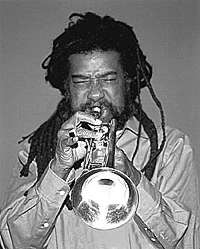
Wadada
Leo Smith today.
|
|
Finally on
Ahkreanvention (1979), we return to a solo Smith. Again we are
faced with the meditative quality of Smith’s work with its
copious use of silence. Love Is A Rare Beauty: Movements 1-5 can
be seen as a sonic sculpture. In the end, that’s what Smith
challenges you to do, to contemplate art in its essence again,
without its familiar forms. In a way, he links the problems we
face in perceiving art as the problems we face in perceiving the
world.
As Smith
has said, "that’s where our world has gone wrong. We have
a world society now that has built a new generation of ideas about
solving conflict based off of war, or creating conflict to dominate
other societies, based off of war and economics. And it has destroyed
the human heart right now. And this repair - and there’s
a lot to repair and it’s going to take a lot of sincere artists
to do it - and right now I’m afraid that I don’t have
much trust in what’s going to make the repair. And the reason
I don’t have any trust in it is because art is like every
other system right now, and it has become commercial, you see.
Now there’s an underground, and there’s always an underground,
but by and large the commercialization of art has taken away the
value that art has in society. It has lost that value...
"And
how does music solve the problem? It allows the person a moment
to reflect minus the distraction of living and being involved
in living. And that reflection allows them that little moment
with themselves so that they can figure out the best way to maneuver
through this maze of a society. That’s what art does for
us, you see. And if a person that engages in experiencing art
truly does drop the outside when they walk into an area to participate
in art, they will be liberated."
Other jazz articles you might want to read:
 Free Your Ears... And Your Head Will Follow, by Philip Cheah
Albert Ayler: Like Screaming F**K In St Patrick's
Albert Ayler - Holy Ghost; Spiritual Unity, by Philip Cheah
Gilad Atzmon: Liberating The American People, by Philip Cheah
Peter Brotzmann: What A Day In 1984, by Philip Cheah